
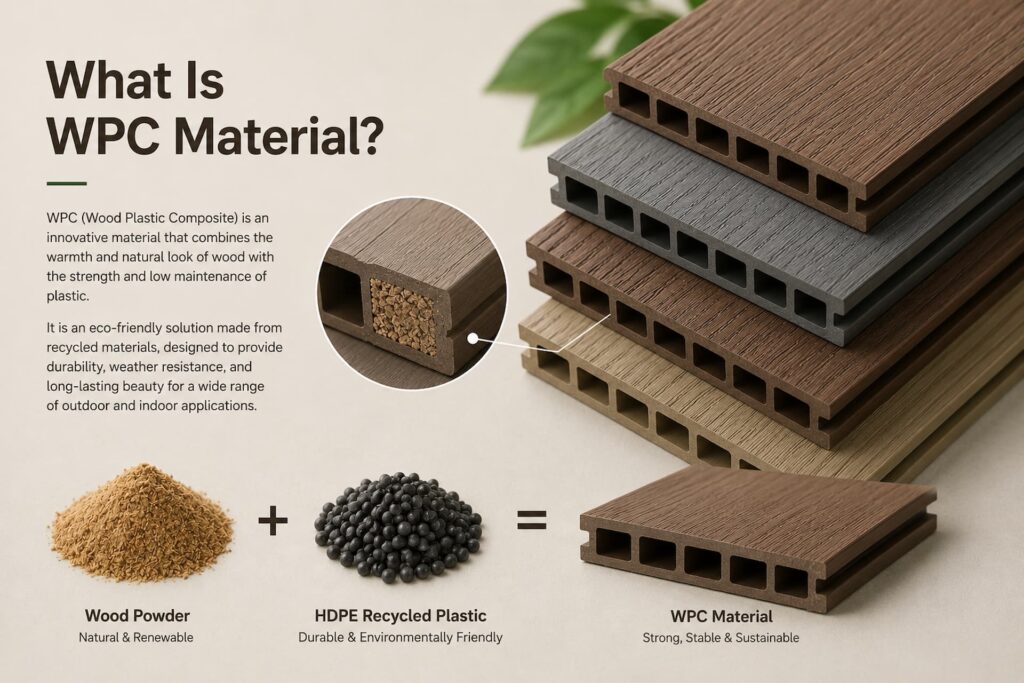
If you’re sourcing materials for an outdoor deck, fence, or facade project, you’ve likely come across the term WPC — but what exactly is it, and why has it become a leading alternative to natural wood?
What does WPC stand for?
WPC stands for Wood Plastic Composite — a hybrid material made by combining recycled wood fibers with thermoplastic resins (typically polyethylene or polypropylene) and a small percentage of additives for color, UV protection, and structural performance.
The result is a material that looks and feels like wood, but performs like engineered plastic — resisting moisture, insects, decay, and color fade for decades.
Composition of WPC
- 50–70% Wood Fiber — usually recycled hardwood or bamboo flour, providing rigidity and the natural wood appearance.
- 25–40% Thermoplastic — recycled HDPE or virgin polymer, providing waterproofing and flexibility.
- 5–10% Additives — UV stabilizers, pigments, coupling agents, and lubricants for processing.
Where is WPC used?
- Decking — outdoor floor boards for residential decks, commercial walkways, pool surrounds.
- Cladding — exterior wall panels for facades, both residential and commercial.
- Fencing — privacy fences, garden boundaries, parking lot enclosures.
- Outdoor Furniture — benches, planters, pergolas.
- Industrial Profiles — railings, soffits, trim.
Why choose WPC over wood?
- Zero maintenance — no sanding, sealing, or repainting.
- Weather and UV resistance — stable across humid, sunny, or freezing climates.
- Insect and rot proof — never termite-damaged.
- Color stability — pigments engineered to resist fading.
- Eco-friendly — uses recycled wood and plastic, reducing landfill waste.
- Longer lifespan — 20–30 years versus 7–15 for treated wood.
Co-extruded vs single-layer WPC
Modern WPC products come in two main grades:
- Single-layer (uncapped) — uniform composition throughout. Cost-efficient, suitable for moderate-traffic applications.
- Co-extruded (capped) — protective polymer cap layer fused over the WPC core. Far superior color stability, scratch resistance, and stain protection. The premium choice for U.S. residential and commercial projects.
Sourcing WPC from a manufacturer
When sourcing WPC for distribution or large projects, look for a manufacturer that offers consistent batch quality, full QC documentation, and reliable export logistics. Vietnam-based manufacturers like Urbancore Green Material are increasingly preferred for U.S. distributors thanks to favorable trade conditions, modern co-extrusion capabilities, and competitive pricing.